
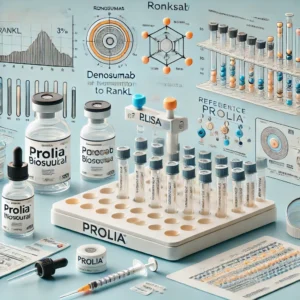
The Prolia Biosimilar Comparison ELISA Kit is designed to measure and differentiate biosimilar versions of Denosumab, a monoclonal antibody used to treat osteoporosis and bone-related conditions. This assay is a vital tool for research, enabling precise quantification of biosimilars, their activity, and immunogenicity compared to the reference biologic, Prolia.
Understanding Denosumab (Prolia)
Denosumab targets RANKL (Receptor Activator of Nuclear Factor Kappa-B Ligand), a key protein that promotes osteoclast activity and bone resorption. By inhibiting RANKL, Denosumab effectively reduces bone loss and increases bone density, as highlighted in research from the NIH and PubMed.
Applications of the Prolia Biosimilar ELISA Kit
- Biosimilar Development and Characterization
This kit facilitates comparative analysis between biosimilars and the originator product, supporting the development of cost-effective alternatives. Regulatory insights from the FDA and EMA guide this process. - Pharmacokinetic and Pharmacodynamic Studies
Analyze the pharmacokinetic profiles and biological activity of biosimilars using validated protocols. Resources such as ClinicalTrials.gov provide examples of ongoing studies. - Immunogenicity Assessment
Detect and quantify anti-drug antibodies (ADA) in patient samples, ensuring safety and efficacy compliance per standards from the World Health Organization (WHO). - Quality Control in Manufacturing
Monitor batch-to-batch consistency and ensure stability of biosimilars during production, adhering to guidelines from the United States Pharmacopeia (USP).
Features of the ELISA Kit
- High Sensitivity and Specificity
- Differentiates between Prolia and biosimilar products with minimal cross-reactivity.
- Detects low concentrations of Denosumab biosimilars in complex matrices.
- Optimized for RANKL-Targeted Assays
- Specifically designed for studying RANKL inhibition.
- Supports preclinical and clinical sample analysis.
- Comprehensive Kit Components
- Includes pre-coated plates, standards, controls, detection antibodies, and buffers.
- Compatible with human serum, plasma, or cell culture supernatant samples.
Technical Specifications
| Feature | Details |
|---|---|
| Detection Range | 10–500 ng/mL |
| Assay Sensitivity | ~5 ng/mL |
| Sample Volume | 50 µL per well |
| Assay Duration | ~3.5 hours |
| Cross-Reactivity | <5% with unrelated monoclonal antibodies |
| Storage Conditions | 2–8°C |
Comparison Between Prolia and Biosimilars
| Property | Prolia (Originator) | Prolia Biosimilar |
|---|---|---|
| Target Molecule | RANKL | RANKL |
| Structure | Fully human IgG2 monoclonal antibody | Similar structure to reference product |
| Clinical Applications | Osteoporosis, bone metastases | Equivalent clinical applications |
| Dosing | Fixed-dose subcutaneous injection | Same dosing regimen |
| Immunogenicity | Low incidence | Comparable immunogenicity |
Advantages of Using the Prolia Biosimilar ELISA Kit
- Enhanced Accuracy
- The kit’s high specificity ensures precise biosimilar characterization, minimizing false positives.
- Standardization Across Studies
- Versatility in Applications
- Suitable for both academic and industrial research, including pharmacovigilance and quality control.
Key Research Areas
- Bone Biology and Osteoporosis Research
Investigating the RANKL pathway’s role in bone resorption. Refer to resources from Harvard Medical School for cutting-edge studies. - Preclinical and Clinical Biosimilar Evaluation
Explore ongoing research on biosimilar efficacy at ClinicalTrials.gov. - Comparative Effectiveness Studies
Assessing therapeutic equivalency, supported by data from PubMed.
Conclusion
The Prolia Biosimilar Comparison ELISA Kit is a state-of-the-art tool for researchers and manufacturers focusing on Denosumab analogs. Its precision, reproducibility, and ease of use make it an essential asset in biosimilar development, preclinical testing, and regulatory compliance.
For more details on this assay or related research, explore authoritative resources like NIH, FDA, and WHO.