
Introduction
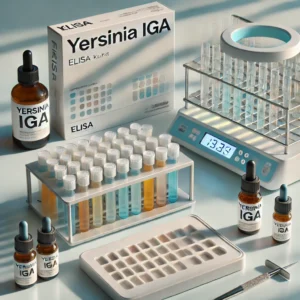
The Yersinia IgA ELISA Kit is a specialized diagnostic tool designed to detect and quantify IgA antibodies against Yersinia species in biological samples such as serum or plasma. This assay is highly sensitive and specific, making it ideal for research and clinical applications, particularly in studying infections caused by Yersinia enterocolitica and Yersinia pseudotuberculosis.
Key Features
- High Sensitivity and Specificity
- Detects IgA antibodies with minimal cross-reactivity to other bacterial antigens.
- Ensures reliable and reproducible results.
- Ready-to-Use Format
- Includes pre-coated plates, standards, and reagents for streamlined workflows.
- Colorimetric Detection
- Utilizes a chromogenic substrate for accurate antibody quantification.
- Broad Sample Compatibility
- Suitable for use with serum, plasma, and other biological fluids.
- Rapid Turnaround Time
- Complete the assay in under 3 hours.
Scientific Background
Yersinia species are gram-negative bacteria responsible for gastrointestinal and systemic infections. Detection of IgA antibodies is particularly important as it reflects mucosal immune responses, providing insights into the host’s recent exposure or ongoing infection.
- Common Diseases: Yersiniosis, mesenteric lymphadenitis, and reactive arthritis.
- Transmission: Contaminated food, water, or direct contact with infected animals.
Explore more about Yersinia infections at CDC Yersinia Resources and NIH Bacterial Pathogen Studies.
Applications
- Clinical Diagnostics
- Confirm Yersinia infections in patients presenting with gastrointestinal symptoms.
- Monitor immune responses in suspected outbreaks.
- Epidemiological Studies
- Study the prevalence of Yersinia infections in different populations.
- Assess infection dynamics in zoonotic transmission pathways.
- Immunology Research
- Investigate IgA-mediated immune responses against Yersinia.
- Explore the role of mucosal immunity in bacterial infections.
Assay Principle
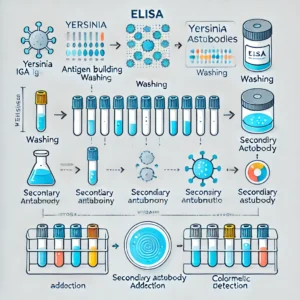
- Specific Antigen Binding:
- The microplate wells are pre-coated with Yersinia-specific antigens to capture IgA antibodies in the sample.
- Secondary Antibody Detection:
- A secondary enzyme-conjugated anti-IgA antibody binds to the captured IgA.
- Colorimetric Reaction:
- A chromogenic substrate reacts with the enzyme, producing a measurable color change proportional to the IgA concentration.
- Quantification:
- Absorbance is measured at 450 nm, and IgA levels are determined using a standard curve.
Kit Components
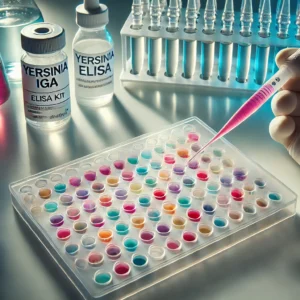
- 96-Well Pre-Coated Plate: Pre-coated with Yersinia-specific antigens.
- Standards and Controls: Calibrated standards for accurate quantification.
- Secondary Antibody Conjugate: HRP-labeled anti-IgA antibody.
- Chromogenic Substrate: TMB (tetramethylbenzidine) for color development.
- Wash Buffer and Assay Diluent: Ensure consistent performance.
- Comprehensive User Manual: Step-by-step instructions for optimal results.
Performance Characteristics
| Parameter | Specification |
|---|---|
| Sensitivity | < 1.0 U/mL |
| Specificity | > 95% |
| Intra-Assay CV | < 10% |
| Inter-Assay CV | < 12% |
Workflow
- Prepare samples, standards, and reagents according to the manual.
- Add standards and samples to the pre-coated wells and incubate.
- Wash the plate to remove unbound components.
- Add the HRP-conjugated secondary antibody and incubate.
- Introduce the TMB substrate for color development.
- Measure absorbance at 450 nm using a plate reader.
- Calculate IgA concentrations using the standard curve.
For detailed protocols, refer to FDA Diagnostic Guidelines or NIH Assay Standards.
Applications in Disease Research
- Gastrointestinal Infections
- Confirm the presence of Yersinia infections in patients with diarrhea, abdominal pain, or fever.
- Reactive Arthritis Studies
- Correlate IgA levels with post-infection autoimmune responses.
- Vaccine Development
- Assess immune responses to Yersinia-based vaccine candidates.
- Zoonotic Transmission Monitoring
- Detect and study infection dynamics in human-animal interfaces.
Advantages
- Fast and Efficient: Complete results in under 3 hours.
- High Specificity: Minimizes false positives from non-Yersinia IgA.
- Scalable: Suitable for both small-scale research and high-throughput diagnostic settings.
Conclusion
The Yersinia IgA ELISA Kit is an indispensable tool for researchers and clinicians working on Yersinia-related diseases. Its high sensitivity, specificity, and rapid workflow make it an ideal choice for detecting IgA antibodies in various sample types.
For ordering or more technical details, visit trusted resources such as NIH Research Tools or FDA Diagnostics.