
The ABTS Antioxidant Assay Kit is a robust and highly sensitive tool designed to evaluate the antioxidant capacity of various biological and chemical samples. The assay is based on the interaction of antioxidants with the ABTS radical cation (ABTS•+), a stable and intensely colored compound, and measures the reduction of the radical to a colorless product. This assay is widely utilized in academic and clinical research to study the antioxidant properties of natural products, pharmaceuticals, and food samples.
Principle of the ABTS Assay
The ABTS assay operates on the principle of colorimetric detection. The ABTS radical cation (ABTS•+) is generated by the oxidation of ABTS using a suitable oxidizing agent, such as potassium persulfate. The presence of antioxidants in the test sample reduces the ABTS•+, leading to a measurable decrease in absorbance at 734 nm. This reduction is directly proportional to the antioxidant activity of the sample. The simplicity, reliability, and adaptability of the ABTS assay make it a popular choice among researchers.
Learn more about the science behind ABTS assays from NIH’s PubChem database and other government-funded resources like NIST Chemistry WebBook.

Applications of ABTS Antioxidant Assay
1. Nutritional Analysis
ABTS assays are extensively used to quantify the antioxidant content in foods and beverages. Studies published by the USDA National Nutrient Database highlight the relevance of antioxidant-rich foods in preventing oxidative stress-related disorders.
2. Natural Product Research
The assay is a staple in evaluating the antioxidant potential of medicinal plants and herbal extracts. Researchers from NCBI have extensively cited its use in identifying bioactive compounds in traditional medicine.
3. Pharmaceutical Development
In drug discovery, the ABTS assay helps screen compounds for antioxidant properties, aiding in the development of therapeutics for oxidative stress-linked diseases like cancer and neurodegeneration (NIH.gov).
4. Environmental Studies
The assay is utilized to study antioxidants in environmental samples, aiding in understanding oxidative balance in ecological systems (EPA.gov).
Advantages of the ABTS Antioxidant Assay
- High Sensitivity: Detects antioxidants in minute concentrations, making it ideal for a variety of applications.
- Versatility: Compatible with both hydrophilic and lipophilic antioxidants, enhancing its usability across diverse sample types.
- Reproducibility: Provides consistent and reliable results, as confirmed by studies funded by the National Science Foundation (NSF).
Key Protocol Steps
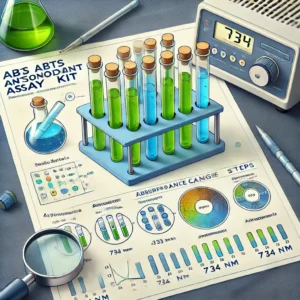
- Preparation of ABTS•+ Solution: ABTS is oxidized to generate the radical cation, which is stable for several hours.
- Sample Addition: Test samples containing antioxidants are mixed with the ABTS•+ solution.
- Incubation: The reaction mixture is incubated for a specified duration, typically 30 minutes.
- Measurement: Absorbance is measured at 734 nm using a spectrophotometer. Antioxidant activity is quantified relative to a standard, such as Trolox.
For a detailed protocol, refer to instructional resources from NIH and CDC’s Laboratory Training Branch.
Comparative Analysis with Other Assays
The ABTS assay is often compared to the DPPH assay, another method for assessing antioxidant activity. A comprehensive evaluation of these methods can be found in publications by FDA and NIST.
Future Directions in Antioxidant Research
As interest in antioxidants continues to grow, the ABTS assay is anticipated to play a pivotal role in advancing our understanding of oxidative stress and its implications in health and disease. Emerging research from NIH and National Center for Complementary and Integrative Health (NCCIH) emphasizes the integration of assays like ABTS in high-throughput screening platforms for drug discovery.
The ABTS Antioxidant Assay Kit remains a cornerstone of antioxidant research, offering unparalleled versatility and precision. Its broad range of applications and ease of use make it an invaluable tool in diverse scientific disciplines.
For further reading, consult peer-reviewed studies hosted on PubMed, CDC, and USDA.